THE TEACHING OF CHRIST AND THE GREEK PHILOSOPHERS
Every science begins with philosophy, in that very moment when some of us asks the question of general importance.
For the civilization known to us, which referes to the period after the Biblical Deluge 2344.BC, the first intellectual activity developed in ancient Greece.
During the period of two centuries – the Greeks refined art, literature, philosophy and science. They left many masterpieces. Science and philosophy begin with Thales of Miletus in the 6th century BC.
The Egyptians and the Babylonians retained a lot of knowledge from the past civilizations, which were later accepted by the Greeks.
Through the legendary character of Orpheus, whom was, according to the legend, ripped, piece by piece by the drunk Maenads, in Greece enters the influence of ancient cruelty of the past civilizations.
The enter of Orphic belief leads to asceticism and an emphasized spiritual ecstasy.
It was believed that this represented the way of uniting with God, and thus acquires mystical knowledge. Orphic influence is, above all evident in the teacing of Pythagoras, who adapted it to his own mysticism. Orphic influence we also find within the religious group of the Essenes in Palestine. Their central religious figure is a ''Teacher of Righteousness,'' whose body, according to the teaching of the Essenes was being cut into half. Such fate is also attributed to the Biblical prophet Isaiah.
This spiritual rapture, which spread through Greece will become a system that will later many religions accomodate to its teachings .
The planet Earth, which carries biological life and human society on it, is not opposite to the divine ideas, the world of grace and heaven, for because the material world was also created by God (The Creator).
The only thing that differs them is that it is governed by the lower God's law - the law of natural justice.
Material world we understand by causal thinking and sensual perception.
Higher reality of human existence could be an idea, through which the existence of matteris manifested. Between the material world and the higher world of ideas there is no substantial difference accept in the highest idea - the knowledge of God. Human's thought ascends from the material world to ideas.
Man, by reason, assumes the truth, but reason itself is not sufficient for reaching higher ideas of God's grace.
What is needed is revelatin. Magnificence lies in that the both truths - reason and revelation come from the Creator and lead to knowledge of God.
Orientation to the idea we could define: - every idea has its own degree of perfection and achieving it, realises itself in biological life.
Every religion begins with one or several combinations of philosophical systems. Heritage could also be a social approach of a philosophical system, or only some parts of image of the certain philosophical system.
Socrates is represented surrounded by his disciples, as Christ is pictured surrounded by his apostles. Philosophical systems serve the religion as a skeleton, on which it will knit its own teachings.
We could conclude that this is the principle in biological life for the spiritual progress of civilization. New religions also embrace the religious systems of earlier civilizations.
The Sumerian system was: God = Anu, Son = Tammuz, Mother Goddess = Nim-Mah.
In Christianity: - God = Father, Son = Christ, Goddess Mother= the Goddess Mary. The influence of philosophers and their systems on the creation of new religion we will understand in the teaching of Christ.
Socrates (469 BC - 399 BC), is one of the most prominent and the most popular figures of Greek philosophy. He did not write anything, the same as Christ, because he thaught that If we ask a question, a book remaines silent.
His philosophical work has refined - developing the dialogues with people on the squares of Athens about the most complex issues.
That was also the manner which Christ used for spreading his ethics of love - arguing with the Pharisees, Sadducees and writers in Palestine.
Socrates was concerned because of the decline of morals of his fellow citizens and their pursuit of wealth rather than virtue and the way to truth. Christ looks at treasures like Socrates, because in wealth the way to virtue and perfection is lost.
Let's notice :
Matthew 19:21/22/23;
''Jesus said: If you want to be complete, go, sell what you own, and give the money to the poor;...''
''But when the young man heard this, he went away sadden because he had many possessions.''
''Then Jesus said to his disciples: I assure you that it will be very hard for a rich person to enter the kingdom of heaven.''
Luke 6:24;
''But how terrible for you who are rich, because you have already received your comfort,''
For Socrates, virtue represents the meaning of life.
One 's life is reflected in strength to respect - moderation, improvement and selfcontrol.
Socrates emphasises an old aphorism -''Know thyself''.
In the Gospel of Thomas, found in Nag-Hammadi, Christ also repeats the saying of Socrates:
Thomas 3;
'' Jesus said... When you come to know yourselves, then you will become known, and you will realize that it is you who are the sons of the living father. But If you will not know yourselves, you dwell in poverty and it is you who are that poverty.''
One of the main principles of Socratic method is awareness of ones ignorance, and this is the first level of the beginning of knowledge. Using irony, Socrates faced the people who claimed to know somethig- with their own ignorance. Through his parables, Christ faced many of the Pharisees and Sadducees with ignorance. Socrates was being accused of not believing in gods in which the state believes, and democracy sentences him to death. Quietly and gracefully he accepts his own death by drinking a pitcher of poison. Heroic death becomes his victory, crowned with glory. The Gospels also focus on Christ's calm acceptance of the conviction of crucifixion.
Matthew 27:12/13/14;
'' When he was accused by the chief priests and the elders, he gave no answer.''
'' Then Pilate asked him , '' Don't you hear the testimony they are bringing against you ?''
'' But Jesus made no reply, not even to a single charge- to the great amazement of the governor.''
Christ's crucifixion is also glorified as the beginning of one of the world's religions.
Plato (427 BC – 347 BC) was one of the greatest ancient philosophers, influenced by the Pythagoreans, Eleatics and ethics of Socrates. For Plato, the visible, material world of phenomena is – only a ''shadow''of ideas. In the hierarchy of
ideas, the greatest is the idea of good, and the purest ideas are numbers. The good represents the purposeful content of reality and the source of existence, because, according to '' the good'' is all existing ( musician is a musician if he is a good musician, otherwise, he is not a musician at all). Goodness as a part of the Christ's teaching we find in the Gospels:
Matthew 12:35/33;
'' A good man brings good things out of the good stored up in him; and an evil man brings evil things out of the evil stored up in him.''
'' Make a tree good and its fruit will be good, or make a tree bad and its fruit will be bad, for a tree is recognized by its fruit. ''
For Plato, perception is not an element for knowing the reflective notions, and there is no continuity in which certain forms of knowledge could link as parts of one entirety.
Plato thinks that immortal soul, before birth, resided in the empire of ides , where it ''observed'' the truth directly.
The visible world of perception the phenomena is only a reminiscence of soul on ideas, because knowledge is nothing else than a memory of soul about the contents, which she knew before the merger with body, and life in the mundane world of shadows. Because of that - soul always finds knowledge in itself. It means that for Plato, ideas are the only reality, the only essences, unchangeable and eternal.
Plato imagined the world as a ball in which center is the Earth, also shaped as a ball. Around the Earth there are stars, oredered in spheres, which are, at the same time, visible blessed beings, with their own life and existence.
That life is reflected in the existence of force to exercise its influence on something, or to receive the other effect.
The highest picture of a supreme being is Cosmos - the world Universe. One such entity couldn't create physically
imperfect world. Such world could only be created by less perfect being - Demiurge, which means a craftsman, artisan. . Demiurge is also a spirit , which is only picturesquely presented as Creator, and indicates the -Reason - the immortal, intellectual part of the soul. Demiurge tried to create the world using ideas as a model, but out of the imperfect matter, created a temporary, imperfect world.
To the fact that biological life is imperfect and that the principle of matter distances a man from the understanding of truth about temporarity of this world, we find in Christ's teaching:
Matthew, 13: 16/18/22/44;
'' But blessed are your eyes because they see, and your ears because they hear.''
'' Listen then to what the parable of the sower means.''
'' But the seed falling on good soil refers to someone who hears the word, but the worries of this life and the difficulties of wealth choke the word, making it unfruitful.''
'' The kingdom of heaven is like treasure hidden in a field. When a man found it, he hid it again, and then in his joy went and sold all he had and bought that field.''
Imperfect is a human's body also, but in it is embedded a soul and in it a Reason –a part of the perfect divine intelligence. According to this understanding of soul, it means - a man by, the divine part of his soul, longs to be similar to the perfect divine intelligence. This kind of view on deity is identical to the teaching of Christ:
Matthew, 5:48;
'' Be perfect, therefore, as your heavenly Father is perfect.''
Plato's immortal soul resided in the realm of God's ideas, where it ''observed'' the truth (God's kingdom), and is now in
us. Such learning is equivalent to Christ's teaching - the kingdom of heaven is within you.
Luke, 17:21;
'' Nor will people say:''Here it is'', or ''There it is '', because the kingdom of God is in your midst.''
For righteousness, Plato had his own definition: -Righteousness is the ownership and operation of what belongs to whom. Plato's definition we find in Christ's teaching.
Luke 20: 21/22/24/25;
'' Teacher, we know that you speak and teach what is right, and that you do not show partiality but teach the way of God in accordance with the truth.''
'' Is it right for us to pay taxes to Caesar or not?''
'' Show me a denarius. Whose image and inscription are on it?
'' Caesar's'', they replied.
'' He said to them, ''Then give back to Caesar what is Caesar's and to God what is God's.''
Plato's philosophy in the hellenistic-Roman world was highly respected and adopted. Plato's explanation of the world, later had an impact on the Gnostics, Neoplatonists and Christians. According to Persian-Gnostic understandings, the Archonats and Demiurge, who created a man are the representatives of independent, opposed to God, the force of Darkness. However, this kind of man also has a divine spark in the form of pneuma (soul) trapped in the body. Some Gnostic approaches equated God of The Old Testament with Demiurge. The basic tool of Demiurge and its Archonats, in order to rule the world is fate - in fact, the laws of physics, by which everything functions. St. Augustine was a Neoplatonist and said: -''Plato's system is the clearest and purest in the whole philosopy''. In his book on Plotinus, Inge said:''It is completely impossible to pull Platonism out of Christianity
and not to tear into pieces Christianity that way.''
Greek and Latin god Mithras (Mithra) was the god of the Sun, and the son of the supreme god of light - Ormuzd. This religion is composed of the Babylonian and old Persian religion. It was widespread among Roman soldiers. Mithras advised people - honest and pure life, in order to protect from Evil. This orientation we find in the teaching of Christ. There were the mysteries by which help ones soul is getting prepared for salvation after death. After the completion of its mission, Mithras returns to Ormuzd, the god of light. From the next chapters we will notice that Christ is also presented to people as a light. After the end of his mission, Christ comes back to his father, like god Mithras did.
John, 8:12;
'' When Jesus spoke again to the people, he said, ''I am the light of the world. Whoever follows me will never walk in darkness, but will have the light of life.''
John 1:4/5; 3:17; 16:5;
'' In him was life, and that was the light of all mankind.''
'' The Light shines in the darkness, and the darkness has not overcome it.''
'' For God did not send his Son into the world to condemn the world, but to save the world through him.''
''But now I am going to him who sent me. None of you asks me:Where are you going?''
The legend of the shepherds who came to bow down the newborn Jesus has its roots in the religion of Mithras. The shepherds come and worship Mithras, who was born from the rock. The Gospels present the same picture.
Luke, 2:8/15;
'' And there were shepherds living out in the fields nearby, keeping watch over their flocks at night.''
'' When the angels had left them and gone into heaven, the shepherds said to one another, ''Let's go to Bethlehem and see this thing that has happened, which the Lord has told us about.''
One of the rites in the religion of Mithras was – taking the consecrated bread and water. In the religious syncretism of the hellenistic world we find the view of:God – the Father, God – the Son, of the Holy Trinity as a unity, of the individual salvation. About the sacrifice of God and the redemption of sin – by the sacrifice.
Abot the sin as a principle of human life and unification with God - by consuming the body of the sacrificed God. We also find the doctrine of soul as a divine part of human being, which is meant to be saved. That is equivalent to Christ's teaching, which the Gospels give us:
Luke 22:19/20;
'' And he took bread, gave thanks and broke ti, and gave it to them, saying; ''This is my body given for you; do this in remembrance of me.''
'' In the same way, after the supper he took the cup, saying, ''This cup is the new covenant in my blood, which is poured out for you.''
Mark 9:12; 14:61/62;
''... is it written that the Son of Man must suffer much and be rejected?''
''... Again the high priest asked him, ''Are you the Messiah, the Son of the Blessed One?''
'' I am,'' said Jesus. ''And you will see the Son of Man sitting at the right hand of the Mighty One and coming on the clouds of heaven.''
Luke 9:20;
'' But what about you? he asked.'' Who do you say I am?''
Peter answered, ''God's Mesiah.''
John 6:38/40/69;
'' For I have come down from heaven not to do my will but to do the will of him who sent me.''
'' For my father's will is that everyone who looks to the Son and believes in him shall have eternal life...''
'' We have come to believe and to know that you are the Holy One of God.''
Aristotle (384 BC - 322 BC) is basically an idealist. He recognizes only the matter as a reality, in contrast to Plato, who does not recognize matter as a reality, but just as the''shadow''.
Aristotle speaks of tragedy as a form of purification of sense. Orphic influence inicialized among the Greek philosophers the thought of seeking the truth and beauty. ted to seek the truth and beauty. This influence is also found in the teaching of Aristotle. In Aristotle's learning, ethics is present only at the level of reason. The soul gives unity to the body and represents the shape for its matter. The goal of ones life - Aristotle sees in the bliss of a reasonable soul. Life of the reasonable soul must continuously be active in virtues, because a virtue represents the means for reaching the goal.
For Aristotle, as for Socrates, the highest goal which one can reach- is contemplative life . Aristotle sees the contemplative life as a thoughtful examination of thruts, already gained and not about discovering new ones. On good and bad things that people do - Aristotle thinks that the action is voluntary , except in cases when it is forced. According to Aristotle, friendship plays a great role in spreanding the selfasteem on others. It is in ones interest that he must love his brother as
himself. Such approach to life we also find in the ethics of Christ.
Luke 16:9/10; 6/13; 10/1;
'' I tell you, use worldly wealth to gain friends for yourselves, so that when it is gone, you will be welcomed into eternal dwellings.''
'' Whoever can be trusted with very little can also be trusted with much, and whoever is dishonest with very little will also be dishonest with much.''
'' When morning came, he called his disciples to him and chose twelve of them, whom he also designated apostles.''
'' After this the Lord appointed seventy- two others and sent them two by two ahead of him to every town and place where he was about to go.''
Mark 7:22/23; 12:31;
'' Adultery, greed, malice, deceit, lewdness, envy, slander, arrogance and folly.''
'' All these evils come from inside and defile a person.''
'' The second of this: '' Love your neighbour as yourself.'' There is no commandment greater than this.''
Matthew 18:35;
'' This is how my heavenly Father will treat each of you unless you forgive your brother or sister from your heart.''
In the third century BC emerges a reaction on Plato's teaching and Aristotle's idealism, in the form of materialist teaching of the Epicureans and the Stoics. For the Stoics the material world and life in it is the only reality, whereas the ideas represent only the apstract marks of the isolated phenomena and concepts. Cosmos is a totality, in which the same world reason includes the whole and also its parts. Human soul is a reflection of divine reason. Cosmos is harmonious, and Greek gods carry the same pneuma (soul) as people – just in greater quantity.
Accordin to their opinion, souls in people are also of material nature, because they consist of ether - the finest substance.
Greek gods are actually equivalent to the biblical sons of God. The teaching of the Stoicks that Greek gods carry the same soul as people, only to a greater extent we find in the Gospel of Judas.
Judas 40/41;
'' But god is a human being, like all the celestial sons and the terrestrial humans, except that he is vastly greater in consciousness than they are.''
'' Creation, however, is of immeasurably higher standing than God, the lord over the celestial sons and terrestrial humans, because Creation is the immeasurable enigma.''
From these chapters we could understand that our ancestors knew about the spiral raising by refining the consciousness. From the narratives we see several dimensions by raising the consciousness - man - the Son of God - God - the Creator. Yahweh – among the Jews it means The One that exists itself, i.e. The One who created all the Universe and everything in it. Jehovah in Hebrew means - THE EXISTING.
The Stoics taught that there is no force, nor action in nature without the presence of matter. The world reason acts by a cosmic plan, in which a part is subordinate to the whole.
By their opinion, the world is not only harmonious, but also good, and evil is dependent on good.
In itself, virtue brings a reward, vice and sin bring the punishment, and evil destroys a vicious man.
Psalm, 140/11; '' May slanderers not be established in the land; may disaster hunt down the violent.''
Matthew 12:34;
'' You brood of vipers, how can you who are evil say anything good? For the mouth speaks what the heart is full of.''
The Stoics, as a concrete movement, had an impact on Christ, similar to Mithraism. Both, the Stoics and Christ preached moral life and faith in divine providence. Within Stoicism the ethical teaching remained unchanged during the entire existence of the movement – for approximately five centuries. This doctrine has its roots in Socrates' way of life - courage in the face of danger, indifference to material circumstances and suffering. These were the virtues that the Stoicks valued , and which are evident in Christ's teaching. The real slavery is slavery to passions.
One, if lives by the rules of virtues, can be free even in the difficult living conditions.
Seneca warns that wealth itself is not good, because it would otherwise make people better.
A big mistake of our modern time is that we see the prehistoric man as hairy, with two stones in his hand.
That is the reason why the Gospels and other records of our ancestors are interpreted incorrectly. Knowledges of our ancestors are no different then the ones today, they are only differently formulated. Archaeologists in tombs find works of art and scientific achievements, characteristical for a man of high civilization and reason. Unfortunately - it does not reach the consciousness of those who shape our civilization. Famous school at the time of Christ, where the law was taught was – GAMALIEL'S. On the Earth there were high civilizations, but were destroyed. That happens because of the cataclysms, which appear cyclically and destroy the science, so it must be started all over again.
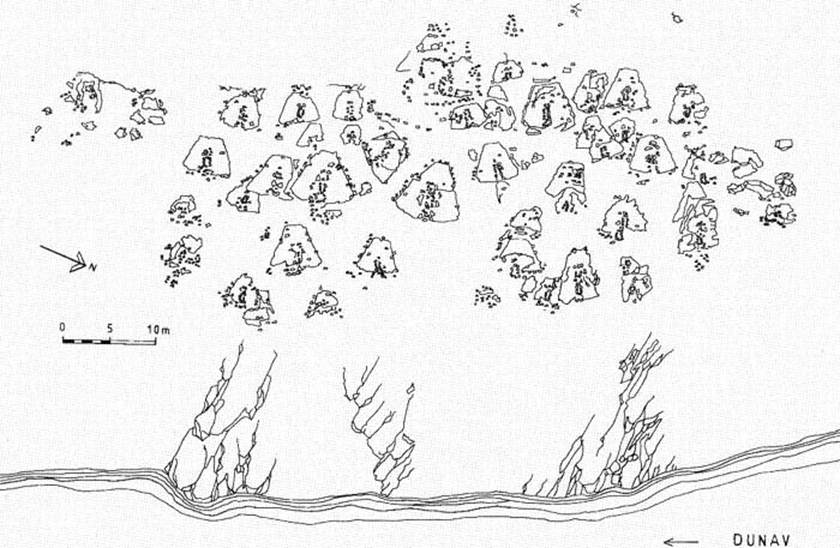
Cataclysms are the revolutionary principle of Cosmos because the Earth refines its second principle, the same as man does. It intertwines with the other planets in the system, creating the perfection of two principles - macro DNA. We document it by illustrations of Lepenski Vir. The Complex of Lepenski Vir was built in the form of several altars where the two principles are separated, and the whole sanctuary has the shape of the upper part of intercepted Earth's hemisphere.
This means that our ancestors 11,000 years ago knew - that the Earth is round, that its axis passes through the constellations and that it represents the separate fiber of DNA .
If science had not gone in the wrong way, we should have not discussed about this now. Man, in biological life, is a separate DNA fiber and focused on the three-dimensional information. One DNA fiber carries three billion letters (vibrations). Improving the second principle (DNA fiber), one gets the opportunity of getting greater number of vibrations
( letters in DNA) and six-dimensional pieces of information. As such - man ends with his biological life and has the possibility for transfer into ''the other dimension''. The Bible calls this process - Ascension to Heaven. This is the dimension of which Christ, philosophers and other religions speak..philosophers and other religion. With the second principle (fiber) refined, one becomes the perfection of two principles. In The Bible that is the son of God.
In the Gospels, Christ sais about it clearly.
John 3:5;
'' Jesus answered, '' Very truly I tell you, no one can enter the kingdom of God unless they are born of water and Spirit.''
DNA molecule is a single, long chain made of two intertwined fibers, which are connected by four bases.
It is a biological computer, or a biological Internet in which coded genetic pieces of information are stored. It is located in the nucleus of each cell, to be exact in salt water similar as the one in the oceans. DNA reacts to language-modulated laser rays and radio waves, if the right frequencies are treated. This way we make our own record and that is why Christ says:
Matthew 12:37;
'' For by your words you will be acquitted, and by your words you will be condemned.''.
Human body can be reprogrammed by words and thoughts, the only thing is that the frequency has to be right. When Christ says: unless they are born of water and Spirit ... in the spirit of our modern times it would mean: who didn't refine his biological computer program (DNA), which is located in water, can not enter the dimension of eternal existence.
About a man as a separated male - the female principle (DNA fiber) also speak the Gospels, found in Nag-Hammadi.
Philip 71/78;
'' When Eve was still Adam, death did not exist. When she was separated from him, death came into being. If he enters again and attains his former self, death will be no more.''
'' If the woman had not separated from the man, she shold not die with the man. His separation became the beginning of death.''
Thomas 114;
'' Simon Peter said to him:'' Let Mary leave us, for women are not worthy of life.''
Jesus said, ''I myself shall lead her in order to make her male, so that she too may become a living spirit resembling your
males. For every woman who will make herself male will enter the kingdom of heaven.''
In all the three statements we see - our ancestors knew that in the third dimension or biological life a separated male - female principle (DNA fiber)is located. The cross, as symbol, also represents the two principles.
Cross in water is vividly (pictoresquely) presented DNA, or two agreed principles of man.
Philip 72;
'' The […] from the dead […] to be, but now […] perfect […] flesh, but this […] is true flesh. […] is not true, but […] only possesses an image of the true.''
1 Corinthians; Paul 15:44/45;
'' It is sown a natural body, it is raised a spiritual body. If there is a natural body, there is also a spiritual body.''
'' So it written: ''The first man Adam became a living being; the last Adam, a life-giving spirit.''
From the last three paragraphs of the Gospel we understand that when developes its second principle, human's body is no longer a''shadow'' like it would be formulated by Plato.
Each cycle on our Planet had its own metaphor of one's existence, but the essence of the message is always the same- man is a being, separated into two fibers of DNA and biological life is not the only dimension of existence in Cosmos. |